

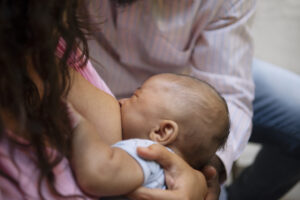
Breastfeeding can become a tense situation for mothers and babies. A brief outline of a simple action model.
In many corners of the world, where basic health services often fail to reach, concerns related to motherhood are pushed to the background in public policy. For this reason, it is said that many maternal actions happen “on the move,” and the streets make this visible through breastfeeding.
Women breastfeed while waiting for the bus, in market corridors, between vegetable stalls, or in improvised popular-economy fairs.
Although breastfeeding is a right and considered a natural practice, doing it with dignity in vulnerable environments remains an unresolved issue. For this reason, in recent years, foundations and community organizations have begun implementing safe breastfeeding spaces inside neighborhood markets and popular fairs.
What began as a punctual response to the lack of breastfeeding spaces has become an initiative that redefines how maternal and child health care is understood in areas lacking essential services.
These are the spaces sustained by small organizations—sometimes made up of fewer than ten people—who operate these maternal-support points with highly positive impact.
Breastfeeding as a public need
Breastfeeding during the first six months of life offers major benefits for newborns and is scientifically recognized as one of the most effective tools for reducing infant mortality, strengthening early bonding, and ensuring adequate nutrition.
But in many low-income neighborhoods, the reality is very different: there are no places where a mother can sit, wash her hands, change a diaper, or simply take a few minutes to calm her baby without being exposed in a public environment.
In fairs where thousands of people circulate every day—and where heat, noise, and lack of safety create unsuitable conditions—breastfeeding becomes uncomfortable and even risky.
These are precisely the conditions that motivated action. Small foundations decided to intervene with a simple idea: creating mobile breastfeeding shelters inspired by hospital lactation rooms, but adapted to informal settings.
The most widespread model is the lactation tent: small foldable structures installed near food stalls or supply centers. They include an ergonomic chair, a water dispenser, a changing table, and a basic first-aid kit so mothers and babies can feel comfortable.
This initiative shows that major investments are not required; some organizations report creating the entire setup for less than the operating cost of a single fair day.
In other places, such as municipal markets, repurposed containers operate as small maternal health centers. These spaces often have trained volunteers specializing in lactation counseling who provide guidance on latch, milk expression, and milk storage, while also offering a cool, safe space away from the crowds.
These containers are equipped with solar panels, cross-ventilation, and signage to help mothers find them easily.
There are also other versions, such as community gazebos used only on fair days and deployed in minutes. Some include curtains for greater privacy; others function as open spaces where breastfeeding is visible and treated as a social practice, reinforcing community bonds.
Regardless of the format, the key lies in their integration with the local environment. They do not seek to replicate the hospital model but to adapt to the reality of informal markets, where dynamics are fast and resources are limited.
Markets and fairs are not only economic centers—they are daily social hubs. Installing lactation spaces there carries strategic value, transforming familiar spaces into urban health nodes and bringing care directly to where people actually are.
Some popular fairs in Latin America have reported a 40% increase in informal breastfeeding consultations after installing these spaces. Many mothers said that without the lactation room, they would have avoided attending the fair or would have breastfed under uncomfortable or unsanitary conditions.
These points also generate a “ripple effect”: merchants offer free water, vendors help with outreach, and neighbors organize as volunteers—creating a chain in which health becomes a shared value within the market.
Safe breastfeeding spaces located in markets and popular fairs not only provide physical safety; they reveal a shift in how maternal and child health is viewed—not solely as a public policy matter, but as a collective responsibility.
The work of small foundations demonstrates that innovation in health does not always arise from large budgets, but from looking closely at real needs and responding with sensitivity through simple, agile solutions.